
Choosing Between 12V and 24V Lighting Systems for Campervans and Motorhomes
Posted on 15th July 2026

Choosing between 12V and 24V campervan lighting starts with the electrical system in your vehicle. Both voltages can power suitable LED lighting, but the fittings, charging equipment and controls must be compatible with the system you choose.
At Aten Lighting, we supply low-voltage LED lighting for campervans, motorhomes and boats. This guide explains the differences between 12V and 24V, why cable length matters and what to discuss with your electrical installer before buying.
The fundamental difference
For the same electrical power, doubling the supply voltage halves the current. Using the relationship power = voltage × current, a nominal 24W load draws 2A at 12V or 1A at 24V. This is an illustration of the principle, rather than a specification for a lighting circuit.
| Supply voltage | Nominal current |
|---|---|
| 12V | 2A |
| 24V | 1A |
Lower current reduces resistive cable losses when the power requirement and cable resistance are the same. It does not, by itself, make a particular cable size suitable. The installer still needs to consider the actual load, cable route, connections and protective devices.
When 12V makes sense
If the leisure electrical system is already designed around 12V, choosing compatible 12V lighting can avoid adding a separate supply for the lights. Check the complete system, including its charging equipment and other accessories, rather than deciding from the number of batteries or the vehicle’s size alone.
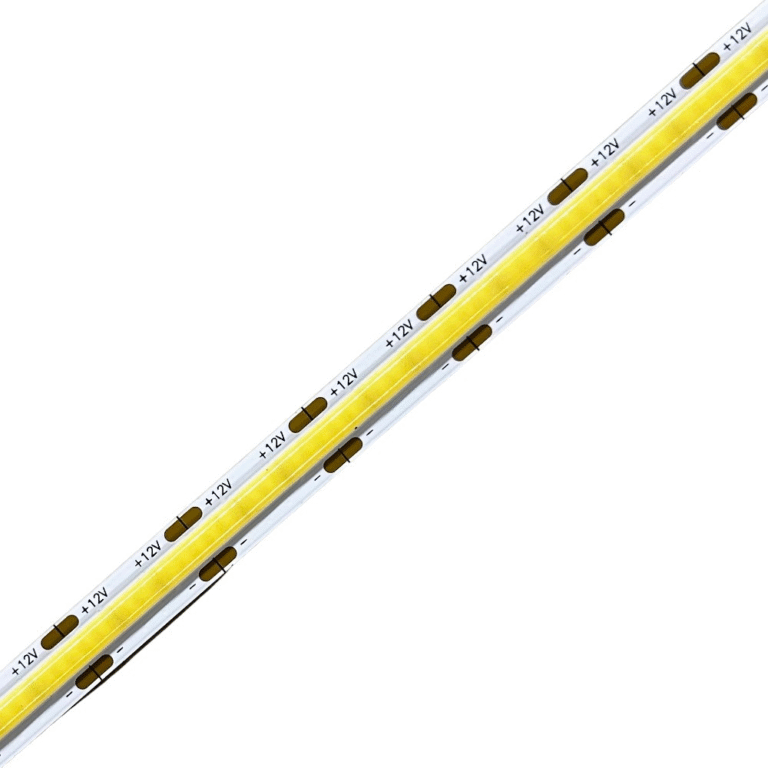
Our campervan LED lighting range includes strip lights, light bars, downlights and reading lights. Some products have a fixed input voltage; others have a specified input range covering both nominal 12V and 24V systems.
When 24V makes sense
A 24V lighting supply may be worth considering when the conversion already has a suitable 24V leisure system, or where the electrical designer identifies a benefit for longer cable routes and higher loads. The lower current for an equivalent load can help reduce cable losses.
Choosing 24V also means checking the supply requirements of every connected light, controller and accessory. A 12V-only product cannot be treated as compatible with a 24V supply simply because both are described as low voltage.
Voltage drop in campervan lighting
Cables and connections have electrical resistance. When current flows, there is a voltage drop between the supply and the load. Cable length, conductor cross-section, current and connection resistance all affect the result. The calculation must include the complete circuit, including the return path.
Excessive voltage drop can contribute to dim or uneven LED-strip output, but these symptoms can have other causes. A circuit needs to keep the light within its specified operating range under the intended conditions.
There is no single cable upgrade that solves every installation. Changing from 1.5mm² to 2.5mm², for example, does not automatically establish that a circuit has acceptable voltage drop or adequate current capacity. Ask your installer to select the cable and protection for the actual circuit.

Example conversion layouts
A compact day van
For a day van with an existing 12V leisure supply, compatible 12V fittings may be a straightforward choice. The installer still needs to check each circuit; a short vehicle does not establish a safe cable size.
A long-wheelbase motorhome
Longer routes make voltage-drop calculations especially relevant. Compare a correctly designed 12V arrangement with a 24V alternative as part of the overall electrical design, including the charging system and appliances.
A bus conversion
An existing 24V vehicle system is a starting point for the discussion, rather than automatic approval to connect new lighting. Confirm the planned leisure supply and its relationship to the vehicle’s original electrical system with the conversion specialist.
Can you mix voltages?
A suitably specified DC-DC converter can supply 12V equipment from a 24V source. Its input range, output rating, installation requirements and circuit protection need to suit the equipment and the complete system. This should be designed into the installation, rather than improvised to make incompatible components work together.
Choosing a system for your build
The best choice depends on the existing supply, planned loads, cable routes and compatible equipment. A well-designed 12V system can suit a campervan, while 24V may offer advantages in another build. A general percentage of conversions cannot decide what is right for yours.
Before ordering, make a list of the fittings and controls you want, then confirm their electrical requirements with your installer. Browse our campervan LEDs or contact Aten Lighting for help checking product specifications.
Frequently asked questions
Is 12V or 24V better for campervan lighting?
Neither voltage is universally better. Match the lighting to the planned electrical system, and have cable losses, protection and compatibility checked for your build.
Do LED strip lights work on both 12V and 24V?
Only if the manufacturer explicitly specifies an input range covering both. Many strips are fixed-voltage products, so check the exact model rather than assuming that it accepts either supply.
Can I convert 24V to 12V in a campervan?
Yes, with an appropriately specified DC-DC converter and a properly designed installation. A converter’s ratings and instructions determine whether it suits the intended load.
Is 24V more efficient than 12V?
For the same power and cable resistance, 24V carries less current and has lower resistive cable losses. The efficiency of the complete system also depends on its equipment and any conversion losses.
What lighting works best in campervans?
Strip lights, light bars, downlights and reading lights serve different purposes. Choose the light output and mounting style you need, then confirm the input voltage, controls and installation conditions for each fitting.
Victron Energy: current, resistance and voltage drop; Victron Energy: DC wiring considerations. Product specifications and installation instructions remain specific to the equipment chosen.
